
Guidance and recommendations
Get prepared.
What the Government recommends every household keeps ready for an emergency, what your First72 kit already covers, and what to add yourself.
Prefer a list to tick off? A free checklist for every emergency, in your order →
Step 1
Add to your First72 bag
Your kit holds the equipment for the first 72 hours. Six things are personal, or need changing over time, so they are yours to add. Keep them in the bag: if you are asked to leave home quickly, you take one bag and go.
Water
A 1.5 litre bottle of drinking water. The Government recommends a minimum of 2.5 to 3 litres per person per day, so keep more at home.
A change of clothes
With a warm layer and spare socks. Layered clothing and blankets are how the Government suggests keeping warm when the heating is off.
Food
A little food that keeps and needs no cooking, such as ready-to-eat tins, with a tin opener if they need one.
Toiletries
A toothbrush, toothpaste and basic toiletries, with hand sanitiser and wet wipes for when the water is off.
Your medicines
Enough of the medicines you take to keep you going for several days, a copy of your prescription and spare glasses.
Your documents
In the document case: passports, birth certificates, insurance policies and your household emergency plan, with important numbers on paper.
Step 2
Keep at home
The Government asks every household to think about what it would need in an emergency lasting a few days: a power cut, the water going off, or being told to stay at home. Here is its home emergency kit, item by item, and where First72 fits.
Where the official advice stops
Warnings arrive. Instructions often don’t.
Emergency Alerts now reach most mobile phones. The practical answer to “where do I go?” is often missing: the Government’s Prepare website covers 18 hazards and advises going indoors, but no official source tells you where to take shelter, and there are no shelter signs in our streets.
“We do not hold any information relating to the provision or location of public shelters or air-raid sirens.”
Greater London Authority, answering a Freedom of Information request about shelters in London, April 2026
So decide now, while it is calm
- If you were told to take shelter, where would you go: at home, at work, on the way between them?
- If a fire or a flood closed the roads around you, which way would you leave, and where would your household meet?
- If the power and the mobile network were down, how would you hear what to do?
Write the answers down on paper and keep them in your document case. The plan is yours, and so is the kit: ready before anyone tells you where to go.
Step 3
Make a plan
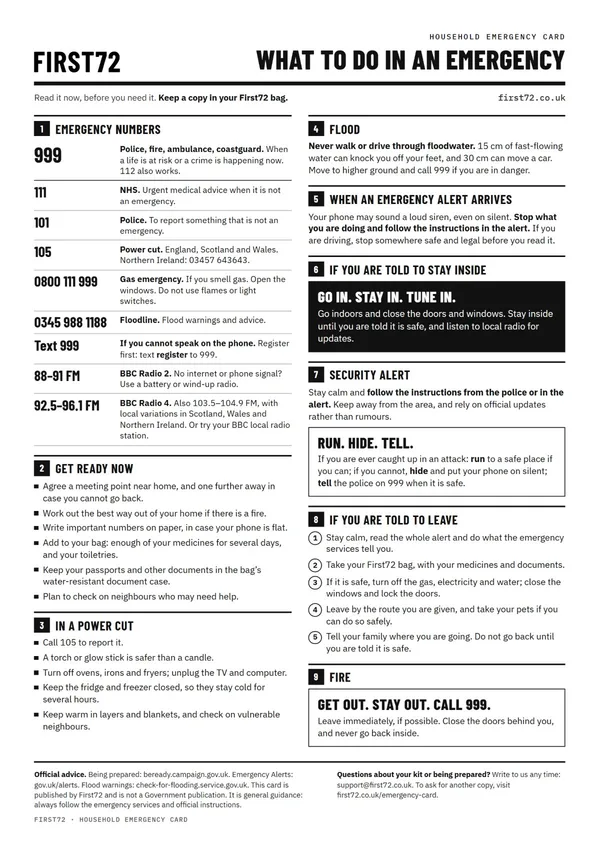
A few minutes now saves confusion later. Our free emergency card puts the essentials on one page, ready to print.
Get the emergency card by email- Work out the best escape route from your home if there is a fire.
- Decide on a meeting point for situations where you might not be able to return home.
- Write down important phone numbers on paper and store them somewhere easy to find in a power cut.
- Write it all down and keep it with your passports, birth certificates and insurance policies: in your First72 document case.
- Add emergency contacts or medical information to your mobile phone.
- Make a plan to check in on neighbours if an emergency happens, particularly if the power goes out.
Before a power cut
- Keep a battery or wind-up torch (and spare batteries) at home. Torches are safer than candles.
- Keep some bottled water and non-perishable food that doesn’t need cooking.
- If you’re eligible, sign up to your energy supplier’s Priority Services Register.
During a power cut
- Call 105 to report it in England, Scotland and Wales. In Northern Ireland, call 03457 643643.
- Turn off items such as irons, ovens, electric fires and fryers, and unplug your TV and computer.
- Keep fridge and freezer doors closed, so they stay cold for several hours.
- Check in on vulnerable neighbours and, if you can, offer to share blankets, clothing or food.
- Keep warm with blankets and layered clothing.
When an Emergency Alert arrives
- Emergency Alerts is a UK Government service that warns you if there is a danger to life nearby. Your phone may make a loud siren-like sound, even if it is set to silent.
- When you get an alert, stop what you are doing and follow the instructions of the alert.
- If you are driving, find a safe, legal place to stop before you read the message, or listen to live radio news.
In a security alert
- Stay calm and follow the instructions from the police or in the alert.
- If you are ever caught up in an attack: run to a safe place if you can; if you cannot, hide out of sight and put your phone on silent; tell the police on 999 when it is safe.
- Keep away from the area, and rely on official updates rather than rumours.
The AM/FM radio in your First72 kit keeps you informed when the power or the mobile network is down.
Write them down
Emergency numbers
If you cannot speak on the phone, you can contact 999 by text once you have registered: text register to 999.
Print it and keep it in your bag
These numbers and what to do in an emergency, on one A4 page in black and white, based on official UK advice.
Questions? We are here to help.
Write to us any time for advice on your kit and on being prepared: support@first72.co.uk.
See what is in the kitThe official advice on this page is quoted from GOV.UK Prepare and Counter Terrorism Policing (read 17 October 2026) and contains public sector information licensed under the Open Government Licence v3.0. First72 is independent and is not affiliated with or endorsed by the Government or any public body. This page is general guidance: always follow official instructions in an emergency and call 999 if life is at risk.